Introduction
To reflect on who we are as individuals and as a group is an activity that has shaped the construction of social identity. Although the concept of identity is inherently polysemic (Amo, 2022), two main approaches to self-perception can be distinguished: the individual level and the social level (American Psychological Association [APA], 2015). In the first case, identity refers to the individual sense of self defined by a set of physical and psychological characteristics that are not entirely shared with others; whereas in the second, it refers to a variety of social and interpersonal affiliations (such as ethnic background) and social roles. It is precisely this latter perspective in which identity fosters individuals’ integration and the development of a sense of belonging across different life contexts, including education (Alcántar-García & Vázquez-González, 2025).
Mexico is a country in which identity formation has been a central issue. In this context, the educational system has functioned as an instrument for constructing a collective identity, that is, a national identity. Therefore, educational challenges have historically been oriented toward the development of national consciousness and identity (Broca, 2009). In this regard, José Vasconcelos, the first Secretary of Education in the country, proposed during the 1920s the development of Mexican national identity through education (Montemayor, 2021).
The influence of identity promotion within education is not limited to the development of national belonging; rather, its effects vary depending on the educational level. In the case of higher education, Alcántar-García and Vázquez-González (2025), after reviewing publications from 2018 to 2024, found that identity development during the university stage, shaped by cultural factors, positively influences students’ academic performance and their transition into the labor market. Furthermore, this stage also promotes qualities such as self-esteem, emotional stability, persistence in higher education, and professional commitment; all of which are essential soft skills for professional development in the workforce.
It appears that the efforts of Vasconcelos and subsequent figures have contributed to the construction of a collective and national identity through the educational curriculum. As a result, Mexicans are often characterized as a people who take pride in their identity symbols. However, this phenomenon is more complex. Considering the existence of multiple Mexicos, it remains unclear how Mexican university students perceive themselves within a megadiverse country. Moreover, according to Silas (2021), there is a pressing need to study the Mexican university student both as an individual and as part of a collective, whom he describes as the “eternal unknown” (p. 7). This challenge becomes even more complex when approached from the three main regions of the country: north, center, and south. Therefore, to understand how Mexican university students perceive themselves; it is first necessary to examine Mexican identity more broadly.
1. Background Literature
1.1. Mexican Identity
“The history of Mexico is that of a man searching for his affiliation, his origin,” wrote Nobel Laureate in Literature Octavio Paz (2004, p. 23) in his work “El Laberinto de la Soledad” (“The Labyrinth of Solitude”). In fact, this premise was already present in how the Aztec people perceived themselves, as shown in the foundational myth of Tenochtitlan, according to the Mendoza manuscript (Instituto Nacional de Antropología e Historia [INAH], n. d.), which emphasized their glorious origin during the pre-Columbian era. Later, during the Viceregal period, Carlos de Sigüenza and Góngora was a pioneer in proposing the bases of Mexican nationalism (Benítez, 1985), principles that were later adopted by creoles and mestizos in subsequent stages, especially during and after Mexico’s Independence. However, it wasn’t until the post-revolutionary era that reflection on the Mexican identity gained greater relevance, having a significant impact on different artistic expressions such as muralism and, primarily, literature. From the 1950s onwards, there was a surge in reflection on what it means to be Mexican (Bartra, 2017), with Samuel Ramos (2001) being a pioneer in the field with his work “The Profile of Man and Culture in Mexico,” written in 1934.
From literature, great works and authors have highlighted the Mexican identity. Here, the works of great essayists such as the aforementioned Octavio Paz, as well as Carlos Monsivais (1998), Roger Bartra (2013b, 2013a), Leopoldo Zea (2001), among others, have collectively contributed to forming what Roger Bartra (2017) has termed the Philosophical-Literary Corpus of the Mexican, to which, according to this same author, recent empirical evidence has been added, based on psychological and sociological studies, such as the work of Rogelio Díaz-Guerrero (2013) and Santiago Ramírez (1977).
Now, how do these authors describe the Mexican? In the first case, Ramos (2001), in his work published almost 90 years ago, describes the Mexican of that era as someone who self-denigrates in front of what is foreign, which he tries to mimic; therefore, this author proposes the existence of a feeling of inferiority. This same topic was taken up by Octavio Paz (2004), who uses the metaphor of the Mexican mask as an instrument to escape this feeling through disguise and denial. Bartra (2013a) uses the metaphor of the stooping hero, which, although it does not share the same vision as the previous authors, this comes to form part of what Bartra (2017) calls a “Psychological Drama” (p. 15). Similar characteristics –e.g., insecurity, need for origin, lack of identity– are found in the work of Ramírez (1977).
Another source, although from an anthropological approach, that has allowed us to understand the Mexican has been Hofstede (2024), who conceives Mexico as a collectivist country, with a short-term vision and high levels of power distance, achievement motivation, uncertainty avoidance, and self-indulgence; aspects that denote its national culture.
On the other hand, Santiago Ramírez (1977) highlights that studies on the description and motivations of the Mexican are scarce from a psychological approach. This is despite the fact that psychology is the “study of the mind and behavior” (APA, 2015), therefore, it could significantly contribute to the discussion about what defines the Mexican, which, as already mentioned, has been a topic mainly studied by experts in literature and philosophy. Under this approach, Díaz-Guerrero (1972; 2008, cited by Alarcón, 2010), found characteristic traits of the Mexican psychology such as machismo, affiliative obedience, and respect over love.
Derived from this, the need for more studies on the topic is observed, especially studies that employ psychological methods. In this vein, three types of studies stand out that have used psychological concepts and methodologies to study the behavior of the Mexican population: (1) theoretical studies that reflect on what distinguishes the Mexican through theories about human and social behavior (e.g., Ramírez, 1977; Ramos, 2001; Rodríguez & Ramírez-Buendía, 2004); (2) those that have used empirical evidence to test the theoretical hypotheses put forward by different essayists (e.g., Díaz-Guerrero, 1972, 2013); (3) more current studies that have used emerging methodologies (e.g., Figueroa et al., 2012; Vera-Noriega et al., 2005).
Figueroa et al. (2012), in particular, studied the population of the state of San Luis Potosí, Mexico, through a quantitative research, where they found that the two most significant concepts to describe the self-perception of Mexicans were being hardworking, sincere, honest, and solidary; while in the case of Mexicans in general, they found that these were identified to a greater extent only as hardworking. Regarding the second, Vera Noriega et al. (2003), when studying 1000 subjects living in the state of Sonora, found that the qualities most used to describe themselves were hospitality, brotherhood, and sociability.
1.2. Conceptual framework: Identity and the University in Mexico
The Mexican people have tried to raise awareness about who they are, about what is distinctive about them (Zea, 2001). In fact, according to Bartra (2017, p. 16), “there is a thirst for identity in this country.” This impacts all sectors of Mexican society, where the educational area stands out, which has historically experienced deficiencies compared to other educational systems. Within these, the poor results of Mexican students in the PISA test created by the Organization for Economic Cooperation and Development (OECD) stand out, which negatively impact the Human Development Index (Palafox, 2023). In fact, according to this index published by the United Nations (2024), Mexico ranks 77th worldwide, with education being one of the areas that require greater attention. Additionally, only one Mexican university is ranked within the Top-100 in the QS World University Rankings 2025, while only nine are ranked within the Top-1000 Worldwide (QS Top Universities, 2024).
Now, how could the study of the psychology of the Mexican contribute to the improvement of education in Mexico? To answer this question, it is important to recognize that, as Bartra (2017) concludes, Mexican culture has created several archetypes for its own description and understanding. This has created a great academic debate. For the past 100 years –without mentioning that this could date back to the colonial era,– writers, both essayists and experts in social and human behavior studies, have highlighted the existence of negative characteristics that describe the Mexican; however, there are also those who criticize some of these characteristics, such as sociologist Roger Bartra (2017) and psychologist Díaz-Guerrero (2013), noting that the latter provided empirical evidence, using students as study subject.
Some intellectuals drew on different philosophical and/or psychological theories as a basis to study the behavior of the Mexican. For example, Samuel Ramos (2001) based his work on that of Jung and Adler; Santiago Ramírez (1977), on psychoanalysis, preferably Freudian; Rodríguez and Ramírez-Buendía (2004), on the humanistic vision based on Abraham Maslow’s theory of needs; while Díaz-Guerrero –in addition to being influenced by the intellectuals of his time (e.g., Antonio Caso, Samuel Ramos, etc.)–, within his psychological approach, engaged with the ideas of Kenneth Spence and Kurt Lewin (Carrascoza-Venegas, 2003). Now, considering that psychology has made certain advances, the behavior of the Mexican could be studied from another perspective.
1.3. Theoretical framework: positive psychology in Mexican university
An emerging view within the psychological field has been positive psychology, which, instead of emphasizing people’s disorders –as traditional psychology has done– focuses on what enables individuals to develop (Ben-Shahar, 2019; Seligman, 2011). According to Lyubomirsky (2021), empirical evidence supports the use of positive psychology with university students. This approach promotes self-awareness as a basis for achieving higher levels of happiness (Lambert et al., 2015), Its study within the university context has increased in recent years (Rodríguez, 2025).
The application of this theoretical approach within universities has not only contributed to reducing depression among students (Tarrats-Pons et al., 2025), but has also fostered the development of social skills, optimism, emotional awareness, and problem-solving abilities. It should be noted that these skills are not only essential for successfully completing university studies but are also crucial for competing in the labor market (Aomo et al., 2024).
Therefore, revisiting the negative views about the psychology of the Mexican within the works of Ramos (2001), Paz (2004) and others, concepts that are referred to by Bartra (2017) as “stereotypes” that are mimicked in current society, and considering that Mexico is not one of the happiest countries in the world, as it ranked 46th in the World Happiness Report (Helliwell et al., 2022). An updated view is required on what is thought about Mexicans within the university context. Then, positive psychology could allow an emerging approach to how the Mexican university student is perceived. From this premise, the following research question arises: how do university students in Mexico perceive the “average Mexican university student”?
On the other hand, Mexico is a megadiverse and pluricultural country. In the first case, it has a significant climatic diversity that ranges from the arid and semi-arid north that borders the United States, the central part of the country where states with higher levels of development are located, and finally, the southeast where, despite having an abundance of resources, the highest levels of underdevelopment are found (Biodiversidad mexicana, 2023). Regarding the second point, Mexico is home to 68 linguistic groups and 364 languages (Diario Oficial de la Federación & Instituto Nacional de Lenguas Indígenas, 2008). These elements impact the national psychology. For example, according to Bartra (2013a), geography plays a very important role in understanding Mexico’s cultural identity. In fact, according to Rodríguez and Ramírez-Buendía (2004), there are differences in the behavior of people living in the north, center, and south of the country; where it is highlighted that inhabitants of the north need greater effort to survive in extreme climates (cold in winter and hot in summer) with scarce resources, while those living in the south have behavior derived from a greater abundance of natural resources.
While it is true that the studies by Díaz-Guerrero (1972, 2013) provide empirical evidence on the psychology of Mexicans within the school environment, it is essential to acknowledge the complexity of generalizing the results, given that Mexico is a country with a population exceeding 126 million in 2024 (Expansión, 2024). There are differences in what Rodríguez and Ramírez-Buendía (2004, p. 88) term “national psychology.” Furthermore, the existence of diverse realities among the country’s universities is noteworthy, as 27 of the 32 Mexican universities ranked within the Top-1500 in the QS World University Rankings 2025 (QS Top Universities, 2024) are located in the central region, while only four are in the north and one in the south. Additionally, Mexico is a country with significant economic diversity, as the regions that contribute most to the country’s Gross Domestic Product are the central and northern regions, with the southern region having lower development (Instituto Nacional de Estadística y Geografía [INEGI], 2023).
Derived from this context, the second research question arises: What are the interregional differences in the perceptions of Mexican university students regarding the prototypical “average Mexican university student” in the central, northern, and southern regions of Mexico? To investigate these research questions, a comprehensive research design is proposed, incorporating multiple methods and analytical strategies to elucidate the complex dynamics of regional differences in student perceptions.
2. Methods
The study was performed with a descriptive non-experimental quantitative research design. The sample is made up of 460 university student participants from Mexico, which were later integrated into subsamples according to residency region: north, center or south (Table 1).
Table 1
Demographic characteristics of respondents.
|
Characteristics |
North (n= 169) |
Center (n= 128) |
South (n= 163) |
|||
|
Age |
M |
S.D. |
M |
S.D. |
M |
S.D. |
|
Years |
21.9 |
6.7 |
21.5 |
6.9 |
23 |
7.3 |
|
Gender |
f |
% |
f |
% |
f |
% |
|
Feminine |
113 |
66.9% |
80 |
62.5% |
97 |
59.5% |
|
56 |
33.1% |
47 |
36.7% |
66 |
40.5% |
|
|
Agender |
- |
- |
1 |
0.8% |
- |
- |
|
Residency state |
f |
% |
f |
% |
f |
% |
|
Baja California |
7 |
4.1% |
- |
- |
- |
- |
|
Campeche |
- |
- |
- |
- |
1 |
0.6% |
|
Chiapas |
- |
- |
- |
- |
26 |
16.0% |
|
Colima |
- |
- |
53 |
41.4% |
- |
- |
|
Estado de México |
- |
- |
3 |
2.3% |
- |
- |
|
Hidalgo |
- |
- |
2 |
1.6% |
- |
- |
|
Jalisco |
- |
- |
13 |
10.2% |
- |
- |
|
Nayarit |
- |
- |
44 |
34.4% |
- |
- |
|
Oaxaca |
- |
- |
- |
- |
1 |
0.6% |
|
Quintana Roo |
- |
- |
- |
- |
6 |
3.7% |
|
San Luis Potosí |
- |
- |
7 |
5.5% |
- |
- |
|
Sinaloa |
62 |
36.7% |
- |
- |
- |
- |
|
Sonora |
86 |
50.9% |
- |
- |
0 |
0.0% |
|
Tabasco |
- |
- |
- |
- |
57 |
35.0% |
|
Tamaulipas |
14 |
8.3% |
- |
- |
- |
- |
|
Veracruz |
- |
- |
- |
- |
1 |
0.6% |
|
Yucatán |
- |
- |
- |
- |
71 |
43.6% |
|
Zacatecas |
- |
- |
6 |
4.7% |
- |
- |
|
School level |
f |
% |
f |
% |
f |
% |
|
Highschool |
- |
- |
8 |
6.3% |
- |
- |
|
Tech Superior University Student (TSU) |
5 |
3.0% |
14 |
10.9% |
43 |
26.4% |
|
Undergraduate |
141 |
83.4% |
92 |
71.9% |
117 |
71.8% |
|
Engineering |
16 |
9.5% |
4 |
3.1% |
- |
- |
|
Masters |
3 |
1.8% |
1 |
0.8% |
1 |
0.6% |
|
PhD |
3 |
1.8% |
5 |
3.9% |
1 |
0.6% |
|
Other |
1 |
0.6% |
2 |
1.6% |
- |
- |
|
Non apply |
- |
- |
2 |
1.6% |
1 |
0.6% |
|
Semester |
f |
% |
f |
% |
f |
% |
|
First |
34 |
20.1% |
4 |
3.1% |
84 |
51.5% |
|
Second |
26 |
15.4% |
43 |
33.6% |
1 |
0.6% |
|
Third |
17 |
10.1% |
5 |
3.9% |
17 |
10.4% |
|
Fourth |
6 |
3.6% |
17 |
13.3% |
5 |
3.1% |
|
Fifth |
18 |
10.7% |
19 |
14.8% |
4 |
2.5% |
|
Sixth |
14 |
8.3% |
14 |
10.9% |
3 |
1.8% |
|
Seventh |
39 |
23.1% |
11 |
8.6% |
23 |
14.1% |
|
Tenth |
5 |
3.0% |
6 |
4.7% |
12 |
7.4% |
|
Graduate |
10 |
5.9% |
4 |
3.1% |
5 |
3.1% |
|
Non apply |
- |
- |
5 |
3.9% |
9 |
5.5% |
|
Field of study |
f |
% |
f |
% |
f |
% |
|
Social Sciences & Administration |
117 |
69.2% |
47 |
36.7% |
70 |
42.9% |
|
Exact Sciences |
1 |
0.6% |
- |
- |
2 |
1.2% |
|
Natural Sciences & Agriculture |
2 |
1.6% |
28 |
17.2% |
||
|
Engineering and technology |
40 |
23.7% |
31 |
24.2% |
12 |
7.4% |
|
Health Sciences |
2 |
1.2% |
8 |
6.3% |
34 |
20.9% |
|
Education Sciences & Humanism |
5 |
3.0% |
15 |
11.7% |
4 |
2.5% |
|
Non apply |
1 |
0.6% |
23 |
18.0% |
13 |
8.0% |
|
Did not answer |
3 |
1.8% |
2 |
1.6% |
- |
- |
|
Occupation |
f |
% |
f |
% |
f |
% |
|
Student |
115 |
68.0% |
107 |
83.6% |
131 |
80.4% |
|
Worker |
11 |
6.5% |
4 |
3.1% |
5 |
3.1% |
|
Student with part time job |
43 |
25.4% |
17 |
13.3% |
27 |
16.6% |
Note. Own elaboration with dataset. The data were obtained from 21 universities across the country with the support of members of the RIICET Network.
The dataset was collected through an online survey and distributed via electronic media, with assistance from faculty members of the participating universities on the study. Additionally, participants were invited via social media (e.g., email, WhatsApp, LinkedIn, and X) to reach as many participants as possible. A questionnaire was created including one single affirmation: the main defining characteristic of the “average university student,” the participants were then presented with 50 theoretical conceptualized options from Mexican authors (e.g., Bartra, 2013b; Díaz-Guerrero, 2013; Paz, 2004; Ramos, 2001; Rodríguez & Ramírez-Buendía, 2004) as well as some foreign authors (Hofstede & Hofstede, 2005), used to describe Mexican culture, these qualities were subdivided in 25 deemed positive and 25 negative (e.g., humble –arrogant; mediocre– outstanding; creative – routine; hard worker – lazy; among others).
To evaluate the only affirmation, five relevancy levels were displayed, based on Reyes (1993) semantic networks methodology, formatted as follows: The main characteristic that defines the “average Mexican university student;” “The second most important characteristic that defines the “average Mexican university student;” and so on until the fifth quality. It is important to mention that each one of the options was evaluated through 50 proposed categories, found within the instrument itself. A section was also designed to obtained sociodemographic data from participants (age, gender, state of residency, education level, education field and occupation). The instrument was designed by the authors based on the cited literature. For content validation, an evaluation was carried out by five researchers (expert validity), and subsequently a pilot test was carried out with 50 students; tests proposed as appropriate to validate an instrument of this type, according Castañeda (2016).
The selection of this methodological approach is partly a response to Roger Bartra’s (2013b) critique of the impossibility of using statistics to study social variables associated with identity and culture. Additionally, this technique could provide continuity to similar studies conducted by Figueroa et al. (2012) in San Luis Potosí and Vera Noriega et al. (2003) with a population from Sonora, where they identified the values of Mexicans in general and people from Sonora, respectively. For instance, the former used a dichotomous scale of affirmation or rejection of the presence of a quality within the characterization of Mexicans.
Furthermore, currently, studies on this variable have not been limited solely to essayists and psychologists –as was the case in previous decades– but have also been the subject of emerging methodological approaches, such as those employed by the Mexican consulting firm “LEXIA” to study the dreams and aspirations of Mexicans (Lara, 2023b).
The research objective was to know which characteristics participants consider to represent the average Mexican university student, this was achieved through (Reyes, 1993) semantic networks methodology. It can be understood as an interconnected set of concepts, where each concept has three elements: the concept or property, the label, and the value used for the analysis (Barros Pereira et al., 2022), which facilitates the understanding of interpretive educational and social phenomena (Sandín, 2004), when no validated instrument is available.
The next steps were followed: (1) the data base was cleaned to segment answers from participants, according to state of residency and region; (2) the data was alphabetically organized, according to five categories (e.g., main characteristic, second most important characteristic…); (3) frequencies were obtained from answers for each option; (4) frequencies were then multiplied according to when they were emerge (e.g., main characteristic multiplied by five, second most important characteristic was multiplied by four, and so subsequently, until the fifth characteristic); (5) results from equations were added to obtain semantic weight (SW); (6) afterwards, semantic weights were added, to obtain respective percentage (%) to each answer, this data was divided between 100; (7) with these results a graphic representing regions was created (Figure 1).
Ethical considerations for data recollection are described as follows: (a) the ethical institutional committee approved these study (Dictamen 109 [Expert assessment]); (b) informed consent was provided to participants, where the research objective was explained as well as the study characteristics to guarantee free and voluntary participation; (c) it was informed that they were free to cease to answer the survey at any point; (d) it was declared that the participants gathered data was completely anonymous, confidential, and only to reach the research objective.
3. Results and discussion
The figure indicates that, nationally, participants characterize the average university student in Mexico based on their creativity, education, discipline, intelligence, and dreaminess.
Figure 1
Results at a national level
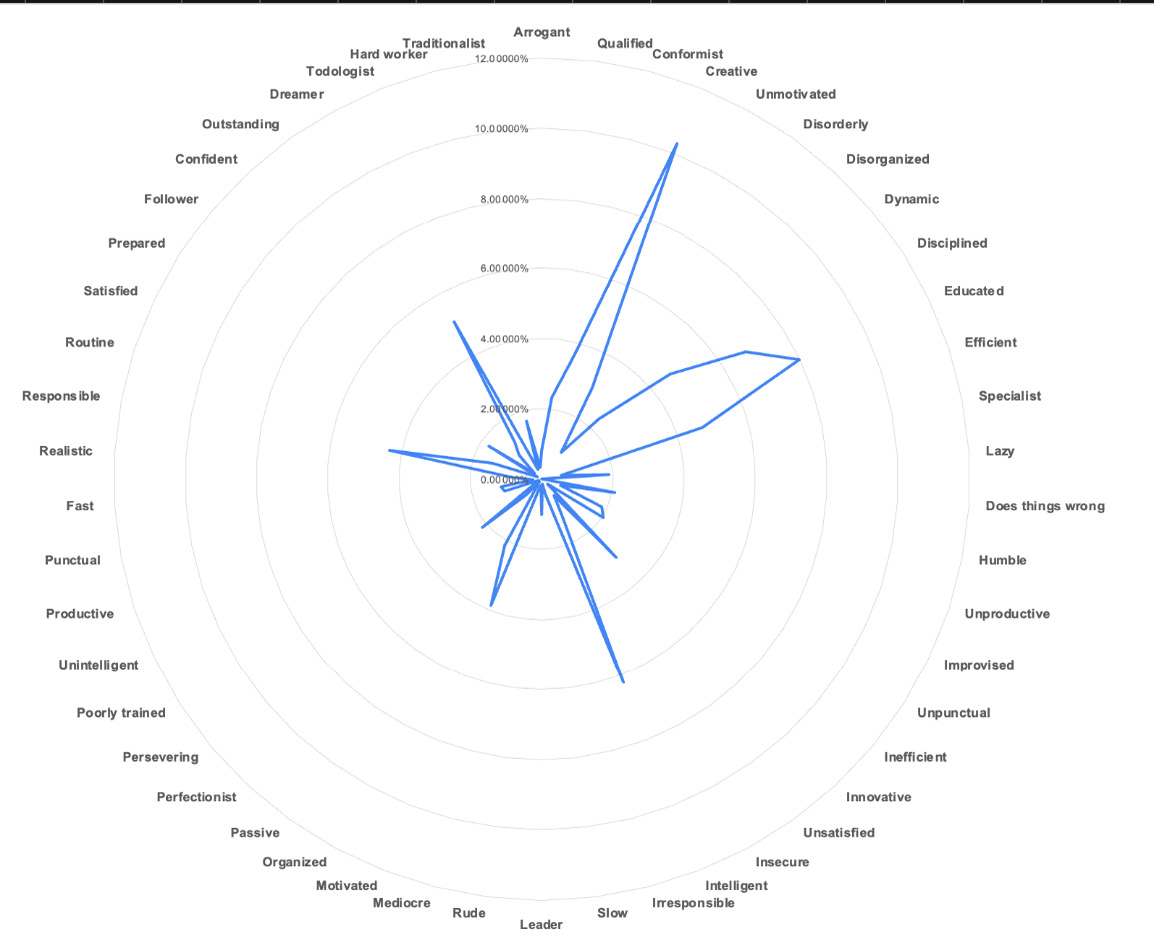
It is highlighted that the study subjects showed a positive vision of the average university student. From the perspective of positive psychology, this shows an important starting point for reflecting on the psychology of the current Mexican. Considering that optimistic people, in addition to being happier, have a greater likelihood of success in life (Ben-Shahar, 2019; Lyubomirsky, 2021; Seligman, 2014). Mexico ranks 58th in the Global Innovation Index 2023, whose extreme indicators (lowest and highest in the ranking) are its institutions (111th place) and the highest - 45th place – creativity (Dutta et al., 2023). However, despite this, the students showed an optimistic vision, placing this characteristic as the one that most defines Mexican students. It is worth noting that this variable is a central axis for the development of education today (Summo et al., 2016) and requires a thorough review in the Mexican context, since, for Rodríguez and Ramírez-Buendía (2004), the lack of promotion of creativity is due to the fact that education is dogmatic and rigid.
The same case is found in the second dimension: being educated. Although the measurement of terminal efficiency in university education is not entirely clear (López Suárez et al., 2008), during the 2022-2023 period, the graduation rate from bachelor’s degree programs was 28% compared to the total number of students who entered primary school in the 2006-2007 period (Dirección General de Planeación, Programación y Estadística Educativa, 2023). This shows that there are serious problems with dropout rates in Mexico. Nevertheless, participants showed an optimistic view of the academic performance of university students in this country. This is also observed in the variables “disciplined” and “intelligent”. Regarding the former, theoretical and empirical evidence is controversial. Firstly, our findings do not coincide with archetypes –as Bartra (2017) calls them– that designate Mexicans as someone who self-deprecates and feels inferior (Ramos, 2001), is insecure (Rodríguez & Ramírez-Buendía, 2004), or as shown in Hofstede’s studies (2024) where Mexican culture is distinguished by being a people with a high level of indulgence and low level of self-control. Instead, our results are associated with what was reported by the consulting firm “LEXIA”, which in 2022 found that 60% of Mexicans have faith in themselves (Lara, 2023a). Similar results had already been reported by Rogelio Díaz-Guerrero (2013), based on empirical research.
On the other hand, although the literature on the psychology of Mexicans has not reflected on this topic, there are studies on intelligence in this country. Despite the fact that the measurement of intelligence is still a controversial factor within psychometrics, IQ (Intelligence Quotient) continues to be accepted as a way to measure a person’s intelligence, especially when researching a country’s average IQ. In the case of Mexico, the Talent Service Center (CEDAT, in (Mata, 2016) found that the average IQ in this country has decreased in recent years due to two factors: one social (due to brain drain to other countries) and genetic (due to the fact that with brain drain, their genes are also lost). Despite this, the participants in the study showed an optimistic view of what they consider to be intelligent.
Finally, regarding the fifth quality –being a dreamer– it is important to highlight that this quality has been widely discussed by scholars of the psychology of Mexicans. Samuel Ramos (2001) considers that one of the main problems of Mexicans is the imbalance between reality and their desires. Bartra (2017), in analyzing the work of this author, mentions that “the Mexican has historically faced a contradiction: a disproportion between what they want to do and what they can do” (p. 101). Similarly, Paz (2004) uses the metaphor of wearing masks to protect oneself from an adverse reality, considering that modern man has dreamed awake. Now, if dreaming has been such an important characteristic to define Mexicans, what do Mexicans dream about? The answer can be found in the “LEXIA” study, which mentions that dreams in Mexico are diverse; they are simple and concrete, and when viewed collectively, they are generally focused on family and the favorable valuation of being Mexican (Lara, 2023a).
It’s worth noting that not all the qualities with the highest frequencies were positive. One negative quality that stood out was being conformist. This, within the educational sector, according to Rodríguez and Ramírez-Buendía (2004), is the result of a rigid and dogmatic education within the Mexican context. Others, such as Rojas Cruz (n.d.), attribute it to “valemadrismo” –means a person who maintains an attitude of indifference to everything around him–, which corresponds to a nihilistic, pragmatic, and hedonistic attitude towards reality, where problems are ignored or seemingly ignored. This vision is close to the metaphor of the mask proposed by Paz (2004), where one seeks to escape from adverse reality.
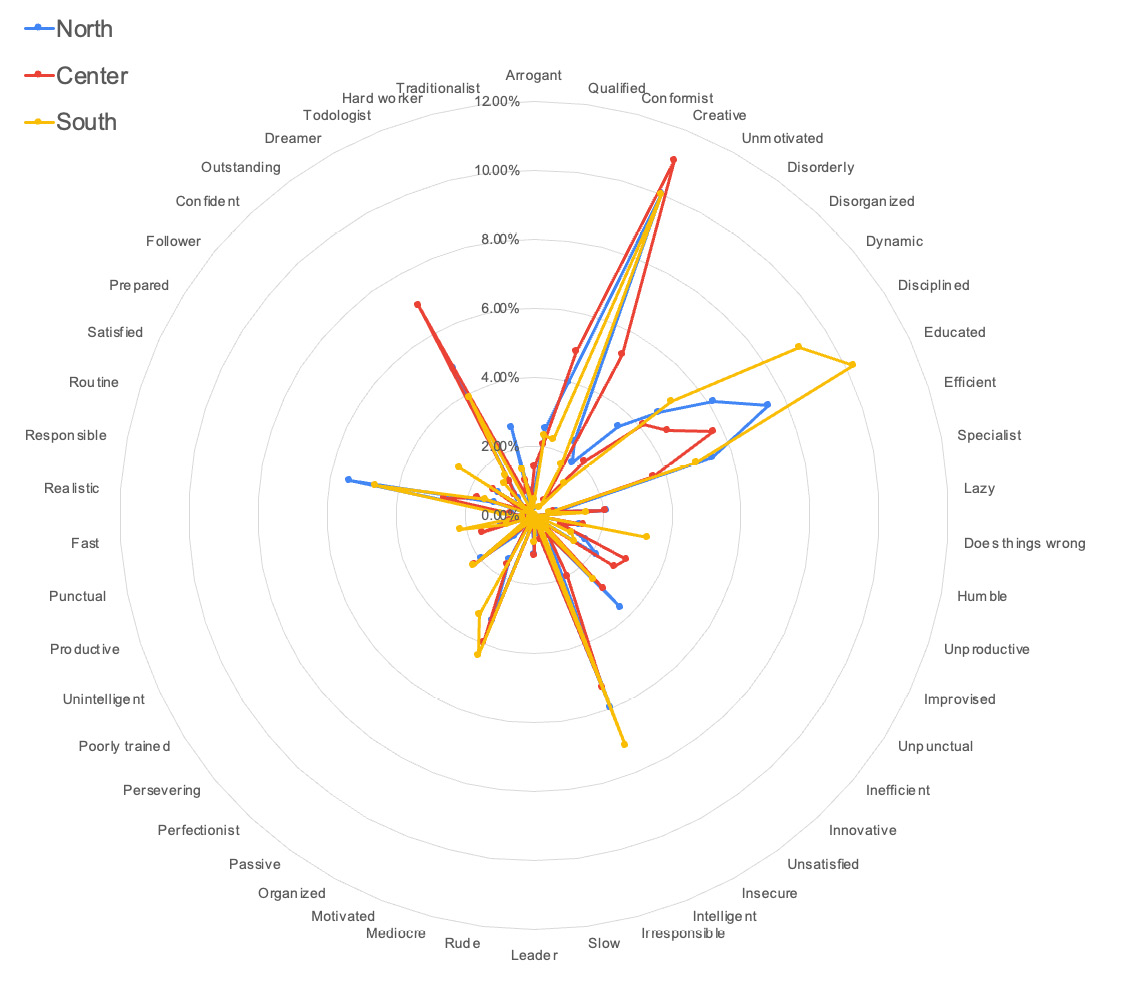
On the other hand, to address the second research question –What are the interregional differences in the perceptions of Mexican university students regarding the prototypical “average Mexican university student” in the central, northern, and southern regions of Mexico?–, a comparative analysis was conducted between the three regions of Mexico (north, center, and south). The results showed that participants from all three regions coincided in several of the qualities chosen to describe the average Mexican university student: creative, educated, disciplined, dreamer, and intelligent. To analyze these results, two premises must be considered: the first assumes a homogeneous view of Mexicans (e.g., Paz, 2004; Ramos, 2001); the second, in contrast, posits that it is not possible to speak of a single Mexico, but rather a great heterogeneity. Bartra (2017) supports the latter premise, stating that the intellectual interpretation of Mexicans is a literary myth, as reality is entirely different. This premise is supported by the “LEXIA” consultancy, which found that there is not one Mexico, but a vast mosaic of dreams and realities (Lara, 2023a).
Under this second posture, and considering the great diversity of the country, it was postulated that there would be different appreciations about the average university student. However, the results seem to support the universalist views of intellectuals (e.g., Paz, 2004; Ramos, 2001). The findings showed that, although the study subjects belonged to different states from the three regions of the country, which, although they are distinguished by being diverse in different contexts (e.g., social, economic, and cultural), as can be seen in Figure 2, the main qualities selected were similar: creative, educated, disciplined, intelligent, among others. Regarding disciplined and educated, the southern zone showed higher levels compared to the north and center of the country, respectively.
Figure 2
Results according to region
4. Conclusions
Individuals and social groups have endeavored to define themselves and differentiate themselves from others. In the case of Mexico, the comprehension of a national conscience has become an academic challenge. This topic has gathered Mexican intellectuals, who have attempted to explain this phenomenon from the humanities perspective as well as the psychological perspective and the anthropological perspective; however, an obvious lack of current empirical evidence has been noted. This has become even more complex when consider that Mexico is a megadiverse country with very noticeable cultural differences marked by significant variations such as language, values, traditions and meanings; thus, demanding research that allow a wider comprehension, providing insight to these elements from different regions of the country.
Considering that another crucial aspect of how Mexican citizens perceive themselves is education, it is relevant to point out that education has become an important stage where it’s possible to find a collective meaning (Bartra, 2013b). Nevertheless, even though university institutions have considerably contributed to the creation of a collective conscience in Mexico, which have at the same time allowed the development of citizens who have further busted social development the study of how students perceive themselves as subjects warrants greater attention, given the evident lack of empirical research (e.g., Chávez-Berrea et al., 2020; Huaire Inacio et al., 2019). The present research provides information about Mexicans perceptions of the average university student and their characteristics, taking into consideration three regions of this country: north, center and south.
This research represents the meaning that Mexican students attribute to the concept of the “average university student.” The information was collected from three regions of Mexico: the north, center and south. Future investigations researching these subjects may use the data presented to better understand Mexican people psychology, topic on which there are some theoretical approaches, but empiric evidence is still lacking and insufficient. The results may be useful for academics from different fields such as psychology, education, sociology, anthropology and economy, but also for administrators of public policies oriented to tend and provide university level development (e.g., promote students’ integral development, implement new learning strategies oriented to the current needs of society and the labor market, and reduce problems such as stress and depression).
In addition, our data may serve as input for different other fields future studies which subject study focuses on variables associated with Mexican psychology (e.g., culture, values, identity, etc.). This paper will prove that the methodology used –semantic networks– would be useful to provide a deeper comprehension of the meaning of certain social constructs, in comparison to other quantitative measurement scale techniques.
This document attempted to intervene in the ancient discussion about who the Mexican is, in this case, within higher education. The tendency to generalize the concept of the average Mexican, or as Bartra (2017) calls it, the canon of the “typical Mexican” (the Mexican”) which is considered by this author as a “powerful cohesive illusion” (p. 20). It seems that, to improve the understanding of who the Mexican is in their different facets, such as within the educational sector, it is important to recognize that there is not one Mexico, but an accumulation of different realities. This premise is empirically supported by the LEXIA consultancy (Lara, 2023a, 2023b); however, the results found here –contrary to what was postulated–showed that there is a certain homogeneity within the vision of the Mexican student.
It is important to point out that, although some intellectuals have mentioned that Mexicans may present certain weaknesses such as a feeling of inferiority (Ramos, 2001), low self-esteem (Rodríguez & Ramírez-Buendía, 2004), denial of reality (Paz, 2004; Ramírez, 1977), among others, which focus on a historical wound resulting from the Spanish conquest. In a globalized and interconnected world, the Mexican has changed. This is demonstrated by Díaz-Guerrero (2013) and Lara (2023b), in addition to the results shown in the present study.
Just as the Mexican has changed, so too have the psychological theories that can help understand their behavior. That’s why premises of theories like those proposed by positive psychology can help identify the ailments and areas of opportunity for Mexican students, who will be tomorrow’s professionals. Empirically, positive psychology has grown in relevance in Mexico (Salamanca-Camargo et al., 2024), and research has shown that it can be used to develop various skills necessary for success in college and in the job market (Aomo et al., 2024; Tarrats-Pons et al., 2025).
For example, to educate a more creative Mexican, Rodríguez and Ramírez-Buendía (2004) recommend strengthening self-esteem. In this way, by studying variables that study this theory (e.g., resilience, happiness, sense of life, etc.), pedagogical proposals (e.g., strengths-based learning, gratitude and mindfulness practices, collaborative work, formative assessment) could be generated that responds to the needs of today’s Mexico, which differs from what the great intellectuals who have been cited lived. This proposal not only refers to a way of understanding the Mexican student but also as a proposal to generate strategies to improve their academic performance and the formation of soft skills required by the current world.
Limitations
Despite having a sample of 460 participants, this might be limited to represent the whole population of Mexico.
Acknowledgements
We extent a sincere gratitude to the Program for Promotion and Support of Research (PROFAPI, 2024) of the Instituto Tecnológico de Sonora for all the financial support to make this research possible.
Declaration of competing interests
The authors declare that they have no known competing financial interests or personal relationships that could have appeared to influence the work reported in this paper. During the preparation of this work the author(s) used DeepL to check grammar. After using this tool/service, the author(s) reviewed and edited the content as needed and take(s) full responsibility for the content of the publication.
Credit author statement
MANR: Conceptualization, Methodology, Data curation, Funding acquisition, Investigation, Writing – original draft; KAGR: Formal Analysis, Investigation, Writing – original draft; MRC: Visualization, Writing – original draft.
Database storage
The data used in this research is available from OSF via the following link: https://osf.io/hp69s/?view_only=be6ee6e73492403a9892c94c8ca8ced6
References
Alarcón, R. (2010). El legado psicológico de Rogelio Díaz-Guerrero. Estudos e Pesquisas em Psicologia, 10(2), 553-571.
Alcántar-García, A. K., & Vázquez-González, G. C. (2025). Importancia de la identidad y el sentido de pertenencia en el proceso formativo del estudiante universitario. Interpretextos Revista Semestral de creación y divulgación de las Humanidades (Colima), 2(4), 171-188. https://doi.org/10.53897/RevInterp.2025.04.09
American Psychological Association. (APA, 2015). APA dictionary of psychology (2nd ed.). American Psychological Association.
Amo, R. (2022). La identidad: definición, fundamentos y actualidad de la cuestión. Scripta Fulgentina, 32(63-64), 7-22.
Aomo, J.A., Aloka, P.J., Mukadi, E.B., Mnyamana, N., Okello, L., Onyango, T.K.O. (2024). Benefits of Positive Psychology to Freshmen at Universities: An Integrated Literature Review. In Aloka, P.J. (eds), Utilising Positive Psychology for the Transition into University Life (pp 201–216). Palgrave Macmillan, Cham. https://doi.org/10.1007/978-3-031-72520-3_12
Bartra, R. (2013a). La sangre y la tinta. Ensayos sobre la condición postmexicana. Debolsillo.
Bartra, R. (2013b). Oficio mexicano. Debolsillo.
Bartra, R. (2017). La jaula de la melancolía. Identidad y metamorfosis del mexicano. Debolsillo.
Benítez, L. (1985). Nacionalismo en Carlos de Singüeza y Góngora. Estudios de Historia Novohispana, 8(8), 203-221.
Ben-Shahar, T. (2019). La búsqueda de la felicidad. Planeta Publishing.
Biodiversidad mexicana. (2023, agosto 27). México megadiverso. https://www.biodiversidad.gob.mx/pais/quees
Broca, V. (2009). La identidad Mexicana y el problema educativo. Cinzontle, 3(2), 41-48. https://revistacinzontle.ujat.mx/Cinzontle/article/view/2215
Carrascoza-Venegas, C. A. (2003). Rogelio Díaz-Guerrero: Pionero de la psicología experimental en México. Psicología y Ciencia Social, 5(2), 3-22.
Castañeda Morfín, A. (2016). Las redes semánticas naturales como estrategia metodológica para conocer las representaciones sociales acerca de la investigación en el contexto de la formación profesional de los comunicadores. Estudios sobre las Culturas Contemporáneas, XXII(43), 123-168. http://www.redalyc.org/articulo.oa?id=31646035006
Chávez-Berrea, M., Flores-Tapia, A. F., Castillo-Nava, P., & Méndez-Lozano, S. M. (2020). El autoconcepto en universitarios y su relación con rendimiento escolar. Revista de Educación y Desarrollo, 53, 37-47.
de Barros Pereira, H. B., Grilo, M., de Sousa Fadigas, I., de Souza Junior, C. T., do Vale Cunha, M., Barreto, R. S. F. D., ... & Henrique, T. (2022). Systematic review of the “semantic network” definitions. Expert Systems with Applications, 210, 118455. https://doi.org/10.1016/j.eswa.2022.118455
Diario Oficial de la Federación (DOF), & Instituto Nacional de Lenguas Indígenas (INALI). (2008, enero 14). CATALOGO de las Lenguas Indígenas Nacionales: Variantes Lingüísticas de México con sus autodenominaciones y referencias geoestadísticas. https://www.inali.gob.mx/pdf/CLIN_completo.pdf
Díaz-Guerrero, R. (1972). Una escala factorial de premisas histórico-socioculturales de la familia mexicana. Revista Interamericana de Psicología, 6, 3-4.
Díaz-Guerrero, R. (2013). Psicología del mexicano. Descubrimiento de la etnopsicología. Trillas.
Dirección General de Planeación, Programación y Estadística Educativa. (2023). Principales Cifras del Sistema Educativo Nacional 2022-2023. https://www.planeacion.sep.gob.mx/Doc/estadistica_e_indicadores/principales_cifras/principales_cifras_2022_2023_bolsillo.pdf
Dutta, S., Lanvin, B., Rivera León, L., & Wunsch-Vincent, S. (2023). Global Innovation Index 2023: Innovation in the face of uncertainty (16th ed.). WORLD INTELLECTUAL PROPER.
Expansión. (2024). México: Economía y demografía. https://datosmacro.expansion.com/paises/mexico
Figueroa, K. A., Figueroa, B., Figueroa, B., & Hernández, F. (2012). Análisis de los valores que construyen la identidad del mexicano. Culturales, 8(16), 7-32.
Helliwell, J. F., Wang, S., Huang, H., & Norton, M. (2022). Happiness, Benevolence, and Trust During COVID-19 and Beyond. En J. F. Helliwell, R. Layard, J. D. Sachs, J.-E. De Neve, L. B. Aknin, & S. Wang (Eds.), World Happiness Report 2022 (pp. 13-52). Sustainable Development Solutions Network.
Hofstede, G. H. (2024). The culture factor. https://www.hofstede-insights.com/
Hofstede, G., & Hofstede, G. J. (2005). Cultures and organizations: Software of the mind (2da ed.). McGraw-Hill.
Huaire Inacio, E. J., Marquina-Luján, R. J., & Horna-Calderón, V. E. (2019). Autoconcepto y adaptación a la vida académica en estudiantes ingresantes universitarios. Horizonte de la Ciencia, 9(17), 1-13. https://doi.org/10.26490/uncp.horizonteciencia.2019.17.511
Ibargüengoitia, J. (2019). Instrucciones para vivir en México. Planeta.
Instituto Nacional de Antropología e Historia (INAH, n. d.). Códice Mendoza. https://www.codicemendoza.inah.gob.mx/index.php?lang=spanish
Instituto Nacional de Estadística y Geografía (INEGI). (2023). Producto Interno Bruto por Entidad Federativa (PIBE) 2022, preliminar. https://www.inegi.org.mx/contenidos/saladeprensa/boletines/2023/PIBEF/PIBEF2022.pdf
Lambert, L., Passmore, H.-A., & Holder, M. D. (2015). Foundational frameworks of positive psychology: Mapping well-being orientations. Canadian Psychology / Psychologie Canadienne, 56(3), 311-321. https://doi.org/10.1037/cap0000033
Lara, G. (2023a). ¿Cuáles son los sueños y las aspiraciones de los mexicanos? https://www.marthadebayle.com/especialistas/guido-lara/cuales-son-los-suenos-de-los-mexicanos/
Lara, G. (2023b, mayo 1). Sueños y aspiraciones. https://www.nexos.com.mx/?p=72693
López Suárez, A., Albíter Rodríguez, Á., & Ramírez Revueltas, L. (2008). Eficiencia terminal en la educación superior, la necesidad de un nuevo paradigma. Revista de la educación superior, 37(146), 135-151.
Lyubomirsky, S. (2021). La ciencia de la felicidad: Un método probado para conseguir el bienestar. Urano.
Mata, R. (2016, diciembre 20). La inteligencia en México está disminuyendo por factores genéticos y sociales. https://www.forbes.com.mx/la-inteligencia-en-mexico-esta-disminuyendo/#:~:text=8%3A00%20am-,La%20inteligencia%20en%20M%C3%A9xico%20est%C3%A1%20disminuyendo%20por%20factores%20gen%C3%A9ticos%20y,el%20est%C3%A1ndar%20es%20de%20100.
Montemayor, M.A. (2021). Raíces del sistema educativo mexicano: identidad nacional, memoria y alfabetización. Xipe Totek, Revista del Departamento de Filosofía y Humanidades, 116(2), 141-164. https://doi.org/10.31391/83rjh138
Monsivais, C. (1998). Notas sobre la cultura mexicana en el siglo XX. En D. Cosío Villegas (Ed.), Historia general de México: Volumen II (pp. 1375-1548). El Colegio de México. https://doi.org/10.2307/j.ctv47wf8q
Palafox, J. C. (2023). PISA 2022. PISA 2000, 2018 y 2022. Origen, prepandemia y postpandemia. Voces de la educación, 8(16), 216-267.
Pavía, G.P., & Herrera, J.A. (2025). Construyendo la Identidad nacional: La Importancia del Marco Normativo en la Educación Pública Mexicana. Revista Electrónica Transformar, 6(1), 18-35. https://revistatransformar.cl/index.php/transformar/article/view/154
Paz, O. (2004). El laberinto de la soledad: Postdata; Vuelta a El laberinto de la soledad. Fondo de Cultura Económica.
QS Top Universities. (2024). QS World University Rankings 2025: Top global universities. https://www.topuniversities.com/world-university-rankings?page=6
Ramírez, S. (1977). El mexicano, psicología de sus motivaciones. Grijalbo.
Ramos, S. (2001). El perfil del hombre y la cultura en México. Colección Austral.
Reyes, I. (1993). Las Redes Semánticas Naturales, su conceptualización y su utilización en la Construcción de instrumentos. Revista de Psicología Social y Personalidad, 9(1), 81-97.
Rodríguez, M., & Ramírez-Buendía, P. (2004). Psicología del mexicano en el trabajo (2da ed.). McGraw-Hill.
Rodríguez, Y. (2025). Análisis bibliométrico de la investigación en psicología positiva aplicada a la educación superior. Horizontes Revista de Investigación en Ciencias de la Educación, 9(38), 2222–2240. https://doi.org/10.33996/revistahorizontes.v9i38.1046
Rojas Cruz, A. (n.d.). La realidad del mexicano: Valemadrismo y posmodernidad. https://cultura.buap.mx/observatoriocultural/sites/default/files/Revistas/No.17/La%20realidad%20del%20mexicano%20valemadrismo%20y%20posmodernidad.pdf
Salamanca-Camargo, Y., Londoño Pérez, C., & Tovar-Gamboa, D.N. (2024). Estudio bibliométrico sobre psicología positiva, 2015-2022. En Y. Salamanca-Camargo, & C. Londoño Pérez, Psicología Positiva: Avances en el Sustento Científico (pp. 61-75). Editorial UPTC. https://doi.org/10.19053/uptc.9789586609234
Seligman, M. E. P. (2011). Flourish: A visionary new understanding of happiness and well-being (1. Free Press hardcover ed). Free Press.
Seligman, M. E. P. (2014). Aprenda optimismo: Haga de la vida una experiencia maravillosa (3ra ed.). Debolsillo.
Silas, J. C. (2021). El estudiante universitario, eterno desconocido. Revista latinoamericana de estudios educativos, 51(3), 7-10. https://doi.org/10.48102/rlee.2021.51.3.445
Summo, V., Voisin, S., & Téllez-Méndez, B.-A. (2016). Creatividad: Eje de la educación del siglo. Revista iberoamericana de educación superior, 7(18), 83-98.
Sandín Esteban, Ma. P. (2004). Investigación Cualitativa en Educación. Fundamentos y tradiciones. Mc Graw-Hill.
Tarrats-Pons, E., Mussons-Torras, M., & Jiménez-Pérez, Y. (2025). Efficacy of a Positive Psychology Intervention in Enhancing Optimism and Reducing Depression Among University Students: A Quasi-Experimental Study. Behavioral Sciences, 15(5), 571. https://doi.org/ 10.3390/bs15050571
Vera Noriega, J. Á., Laborín Álvarez, J. F., Domínguez Ibáñez, S. E., & Peña Ramos, M. O. (2003). Identidad psicológica y cultural de los sonorenses. Región y sociedad, 15(28), 3-45.
Vera-Noriega, J. Á., Pimentel, C. E., & Batista de Albuquerque, F. J. (2005). Redes Semánticas: Aspectos Teóricos, Técnicos, Metodológicos y Analíticos. Ra Ximhai, 1(2), 439-451.
Zea, L. (2001). Conciencia y posibilidad del mexicano; El occidente y la conciencia de México; Dos ensayos sobre México y lo mexicano (6ta ed.). Porrúa.