Introduction
Burnout syndrome refers to an inadequate way of facing chronic emotional stress, generated by work and/or academic overload. It is studied through three characteristic features: emotional exhaustion, cynicism, and a perception of decreased personal efficacy1. The term “burnout” was used for the first time in 1974 by Herbert Freudenberger, but it was not until 1981 when Christina Maslach and Susan E. Jackson classified the signs and symptoms of burnout as a syndrome. The questionnaire that they generated has been applied both in work and academic environments, in order to measure the severity of stress in workers or students2.
Burnout syndrome develops gradually, its traits severity increases progressively along its phases of stress, exhaustion, and defensive confronting. The stress phase begins when the work or academic demand exceeds the individual’s resources, generating a situation of stress; then, an exhaustion phase develops when the individual tries to compensate for this lack of resources through overexertion, resulting in symptoms of anxiety, fatigue, and annoyance; the defensive-facing or confronting phase is generated after a change in attitude and behavior, to defend themselves against the stress experienced3.
Workers with high levels of burnout syndrome traits often show signs and symptoms of depersonalization and cynicism, as well as feelings of guilt and failure. In addition, their health and interpersonal relationships, inside and outside work, deteriorate4. Likewise, students with high levels of these traits, show the same signs and symptoms than workers with burnout syndrome, as well as poor levels of satisfaction and/or happiness with their academic career, few expectations of success, and drop-out intention5.
The frequency of the three characteristic features of burnout syndrome have been studied in health workers6, and health sciences students7, revealing high prevalences of the syndrome in both groups. Research on health sciences students, both in Mexico and worldwide, has focused on measuring the prevalence and intensity of burnout syndrome at specific time points8-9. However, information on changes in levels of exhaustion, cynicism, and academic efficacy over an extended period is scarce. This gap requires further study to understand the differences in symptom severity experienced by students at different times along the academic period, such as at the beginning or at the end of an academic semester.
Therefore, the objective of this study was to determine and compare the frequency and severity of the three characteristic features of burnout syndrome in health sciences students at the beginning and end of an academic semester. The hypothesis was that the frequency and severity of exhaustion and cynicism increase, while the perception of academic efficacy at the end of the semester compared to the beginning.
1. Methods
Study design. We carried out a longitudinal study with two time points, at five and sixteen weeks, of an academic semester.
Subjects. Students from health sciences degree programs at a public university were invited to participate. Students who are married or living in a free union, have children or are of guardians of a minor, have been diagnosed with anxiety or depression before starting their current academic program, or who spent more than 25 hours per week to a job were excluded, because, after a literature review, these characteristics were identified as causes of stress unrelated to their academic load10-12. A sample size between 45 and 59 was calculated considered the proportions of health sciences students at risk and the beginning and end of a semester studied [20.5 and 40.9 %, respectively]13 with an alpha value of 0.05 and power of 80-90%.
Sites, measurements and procedure. Health sciences students (Medicine, Physical therapy, Biomedical engineering, Public health, Nursing, and Nutritional Sciences) from the Universidad Autónoma de Chihuahua were invited to participate through social networks or e-mail, including a link to an electronic survey. The first part contained an explanation of the study and a section to accept/decline the participation.
The Maslach Burnout Inventory Student Survey (translated and adapted)14 was applied at the beginning (week five) and the end of the semester (week 16), through Google Forms platform. It consists of 15 questions: five corresponding to the trait of exhaustion, four to cynicism, and six to academic efficacy, with seven possible answers, ranging from 0–6 on the Likert scale. The sum and the average of the score for each of the traits were obtained. They were compared with the normative data to form categories of burnout syndrome severity. The results of the three characteristic features of burnout syndrome were classified into three groups according to the average score obtained in each group of corresponding questions. Low level was classified with scores of 0-1.29 in exhaustion, 0-0.59 in cynicism or 0-3.83 in academic efficacy; medium level with scores of 1.30-2.89 in exhaustion, 0.60-2.25 in cynicism, or 3.84-5.16 in academic efficacy; and high level with scores of ≥2.90 in exhaustion, ≥2.26 in cynicism, and ≥5.17 in academic efficacy15. The burnout syndrome questionnaire has been previously applied in a similar population. It was auto administered, reducing the risk of interviewer bias. Additionally, information on age, sex, career and current semester was collected. The questionnaire link was sent in both time points to all potential participants. Then, fifty-seven students answered the questionnaire in weeks five and sixteen; one hundred and seventeen in week five only, and seventy-nine responded in week sixteen only. These time points were selected because they were outside the programmed evaluation period.
Statistical analysis. An exploratory analysis was performed to verify the frequency and distribution of the data. Data are presented as mean and standard deviation, or as absolute and relative frequencies. The scores obtained by those who answered the surveys at the two moments in which they were applied were compared using the Student’s t test for related samples. This, because it was a quantitative variable with a normal distribution, and since it was the same person at two different times. The changes in the frequencies of the categories within each of the traits, using symmetry tests. The relation between the different trait scores was analyzed by Spearman’s correlation. All statistical analyses were performed with the STATA software version 14.2 (StataCorp, College Station, TX, U.S.A.). A p-value <0.05 was considered statistically significant.
Ethical considerations. The study protocol was approved by the institutional research and ethics committees, and registered under the number CI-044-21. The participation of the students was voluntary and their consent was requested at the beginning of the survey. Because both the invitation and the survey were performed by electronic means, we included the option to accept or not to participate, instead of a handwritten signed form. The questionnaire was displayed only to those who accepted to participate. The information was automatically directed to a database, to which only the researchers have access, to maintain confidentiality.
2. Results
Most participants were within the 20-21-year-old group, a greater proportion were female, medical students, and on the first semester of the program. The frequencies by major and semester were different between those who answered both surveys and those who only answered the first or second (Table 1).
Table 1
Characteristics of the study population, according to the questionnaire response.
|
Variable |
Answered both time points (n=57) |
Answered only at 5th weeks (n=117) |
Answered only at 16th week (n=79) |
|||||
|
n |
% |
n |
% |
n |
% |
p |
||
|
Age (years) |
0.06 |
|||||||
|
18 - 19 |
23 |
40.35 |
33 |
28.21 |
24 |
30.38 |
||
|
20 - 21 |
25 |
43.86 |
40 |
34.19 |
28 |
35.44 |
||
|
≥22 |
9 |
15.79 |
44 |
37.61 |
27 |
34.18 |
||
|
Gender |
0.97 |
|||||||
|
Male |
21 |
36.84 |
41 |
35.04 |
28 |
35.44 |
||
|
Female |
36 |
63.16 |
76 |
64.96 |
51 |
64.56 |
||
|
Program |
<0.01 |
|||||||
|
Medicine |
41 |
71.93 |
41 |
35.04 |
57 |
72.15 |
||
|
Physical therapy |
7 |
12.28 |
27 |
23.08 |
8 |
10.13 |
||
|
Biomedical engineering |
8 |
14.04 |
35 |
29.91 |
8 |
10.13 |
||
|
Public health and others |
1 |
1.75 |
14 |
11.97 |
6 |
7.59 |
||
|
Current semester |
<0.01 |
|||||||
|
1º- 2º |
23 |
40.35 |
32 |
27.35 |
27 |
34.18 |
||
|
3º- 4º |
13 |
22.81 |
8 |
6.84 |
9 |
11.39 |
||
|
5º- 6º |
15 |
26.32 |
39 |
33.33 |
20 |
25.31 |
||
|
≥ 7º |
6 |
10.53 |
38 |
32.47 |
23 |
29.12 |
||
The comparison of the scores of the three characteristic traits in the students who completed both surveys (n=57), showed non-statistically significant difference in the trait of exhaustion of -0.08 ± 0.15, nor in that of cynicism of 0.26 ± 0.14; in academic efficacy they showed lower scores at the end of the semester (-0.22 ± 0.09, p<0.05) (Figure 1).
Figure 1
Score of the three characteristic features of burnout syndrome, at the beginning and end of the semester (n=57).
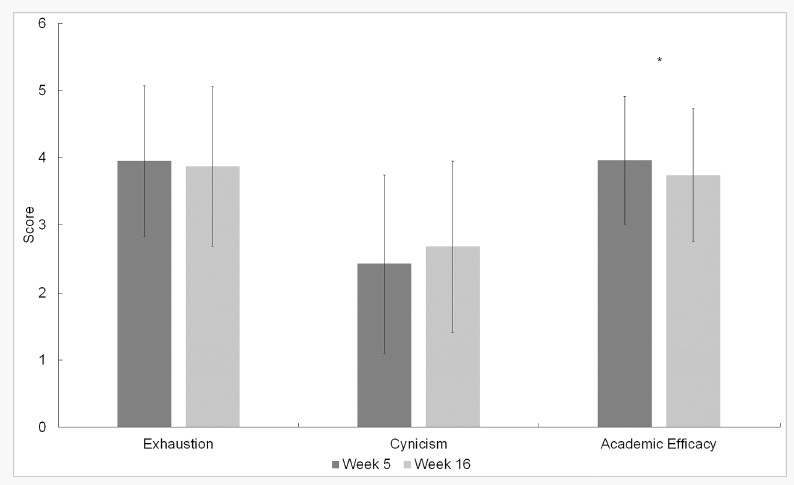
The changes in the severity category of the traits of exhaustion and cynicism did not show a significant difference between the beginning and end of the semester, while the perception of academic efficacy decreased significantly by the end of the semester (Table 2).
Table 2
Frequency and distribution the severity of each characteristic feature of the burnout syndrome, in the students, at the beginning and end of an academic semester (n=57).
|
Time point |
Week 16 |
|||||||
|
Exhaustion level (n) |
||||||||
|
Low |
Medium |
High |
Total |
p |
||||
|
Low |
0 |
0 |
0 |
0 |
0.28 |
|||
|
Medium |
0 |
7 |
5 |
12 |
||||
|
High |
0 |
9 |
36 |
45 |
||||
|
Total |
0 |
16 |
41 |
57 |
||||
|
Cynicism level (n) |
||||||||
|
Low |
Medium |
High |
Total |
p |
||||
|
Week 5 |
Low |
1 |
0 |
0 |
1 |
0.07 |
||
|
Medium |
2 |
13 |
14 |
29 |
||||
|
High |
0 |
6 |
21 |
27 |
||||
|
Total |
3 |
19 |
35 |
57 |
||||
|
Academic efficacy level (n) |
||||||||
|
Low |
Medium |
High |
Total |
p |
||||
|
Low |
23 |
3 |
0 |
26 |
<0.01 |
|||
|
Medium |
10 |
13 |
1 |
24 |
||||
|
High |
0 |
3 |
4 |
7 |
||||
|
Total |
33 |
19 |
5 |
57 |
||||
At the beginning of the semester, the academic efficacy score was inversely correlated with the cynicism trait (rho= -0.4001, p=0.0020), but not with the exhaustion trait (rho= -0.1662, p=0.2165); the correlation of exhaustion and cynicism scores showed a significant direct correlation (rho= 0.5301, p< 0.001). At the end of the semester, academic efficacy was inversely correlated to exhaustion (rho= -0.2518, p=0.0588) and cynicism scores (rho= -0.4381, p< 0.001); while the latter two presented a direct, statistically significant correlation (rho= 0.6045, p< 0.001) (Figure 2).
Figure 2
Correlation between the three characteristic features of burnout syndrome (n=57).
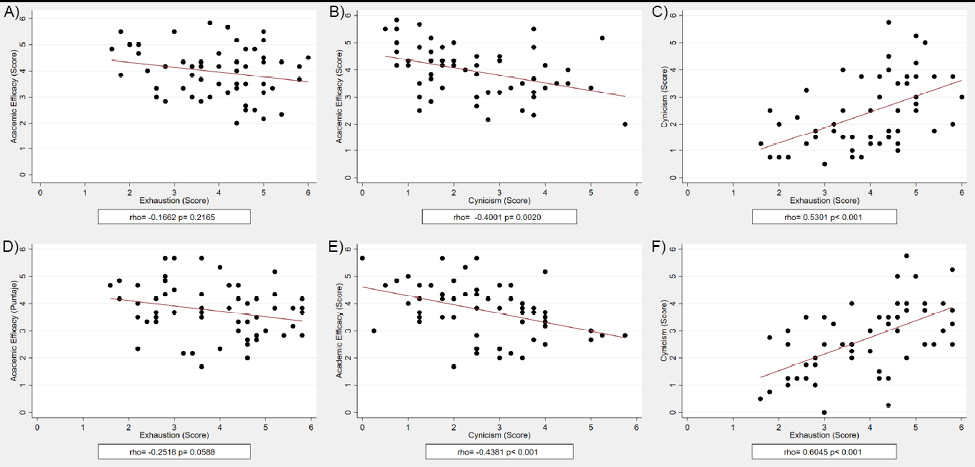
Note. A). Exhaustion and academic efficacy at week 5. B). Cynicism and academic efficacy at week 5. C). Exhaustion and cynicism at week 5. D). Exhaustion and academic efficacy at week 16. E). Cynicism and academic efficacy at week 16. F). Exhaustion and cynicism at week 16.
3. Discussion
The exhaustion and cynicism present in the students at the week five of the semester, were the same compared to week sixteen, instead, high levels of both characteristics were found from the beginning of the semester. Furthermore, there was a decrease in perceived academic efficacy, from a medium level at the beginning of the semester to a low level at the end. There was no significant increase in the number of students reporting higher levels of exhaustion and cynicism in week five compared to week sixteen.However, there was a significant increase in the number of students reporting lower levels of perceived academic efficacy in week five compared to week sixteen.
These results contrast with our hypothesis. We expected an increase in the frequency and severity of exhaustion and cynicism, and a decrease in academic efficacy throughout the semester. Instead, we found high levels of exhaustion and cynicism throughout the semester, along with a decrease in academic efficacy. Soriano-Sánchez (2022)16 reports that an appropriate intervention for individuals suffering from burnout syndrome could help reduce levels of exhaustion and cynicism and increase the levels of academic efficacy, while conversely, a lack of support tends to worsen symptoms. This may explain the decrease in perceived academic efficacy and the increase in the number of students with low perceived academic efficacy. However, it does not explain why there was no significant increase in levels of exhaustion and cynicism, nor a significant increase in the number of students experiencing high levels of exhaustion and cynicism during the semester. The authors of this research theorize that because the participating students already exhibited high levels of exhaustion and cynicism by week five of the semester, there was insufficient margin for an increase in these levels by week sixteen to be statistically significant, moreover there may be other variables that were not considered, such as receiving low or failing grades in the days leading up to the questionnaire. It is possible that in that case, the exhaustion would be similar, but the perception of efficacy would be lower. Regarding the lack of differences found in the other two groups, it is also possible that in the sixth week they were in the period of their first midterm exams, so the exhaustion could be similar; however, it is hypothesized that it is at its peak at the end of the semester. It is also possible that the statistical power was not sufficient to detect a small difference; for example, there is a trend, with p=0.07. Finally, a negative relationship was between the levels of academic efficacy and those of exhaustion and cynicism, and a positive relationship between the levels of exhaustionand those of cynicism. The conclusion was that the greater the exhaustion or cynicism, the lower the academic efficacy, and the greater the exhaustion, the greater the cynicism, which agrees with the findings reported by Kim (2014)17 and Liu (2024)18.
The prevalence of burnout syndrome characteristics shown by participating students could negatively influence the individual, family, social, academic and work environment. It has been reported that people with high levels of exhaustion and cynicism, and low levels of perceived efficacy, tend to have different harmful psychosomatic, behavioral and/or emotional manifestations. They usually present cardio respiratory disorders, headaches, chronic fatigue, sleep disorders, predisposition to addictions, low personal performance, social distancing, emptiness feeling, failure, helplessness, and low self-esteem. This usually worsens over time if the situations that cause it do not change or improve19-20.
Our results are consistent with other studies. For instance, Fontes de Oliva Costa (2012)21, reports inadequate levels of burnout traits in more than half of their sample of medical students, with a higher prevalence in those who did not feel confident in their study skills, or who did enjoy studying. Similarly, Calcides (2019)22, reports high levels of exhaustion and cynicism, and low levels of academic efficacy in around half of the undergraduate interns participating in the study. In addition, they found a high prevalence of students considering dropping out of their studies, reporting not feeling satisfied with teaching strategies, or reporting the use of illicit drugs. Similarly, Chang (2012)23, reports high levels of exhaustion and cynicism, and low levels of academic efficacy in more than half of the medical students analyzed. Amor (2020)24, reported high levels of exhaustion and cynicism, and low levels of academic efficacy, in a third of the medical students analyzed in 2018, and a 10% increase in these values in 2019.
The main limitation of the study is the difficulty in following up with students who responded to the first survey. This is due to the fact that the survey was distributed electronically, anonymously, and voluntarily; therefore, those who responded in week five of the semester were not required to do so in week sixteen. Furthermore, many students who had not responded at the beginning of the semester did so at the end. This necessitated the creation of three study groups and their separate analysis. The results for students who completed the questionnaire at the beginning and end of the semester, those who only completed it at the beginning, and those who only completed it at the end were similar, allowing for generalizations. Significant differences were found only in sociodemographic characteristics; therefore, it was decided to include the data in Table 1. However, the sample size for longitudinal comparison was limited. The study included students currently in their academic program at the university, which includes a clinical component in advanced semesters. Thus, although it was not an exclusion criterion, the questionnaire was not distributed to students doing practices (such as medical internships) or rotations in institutions outside the university.
As analyzed in this study, burnout syndrome is not a foreign or alien phenomenon in higher education institutions; it is constantly present, and more frequently in health sciences programs. Its manifestations can cause severe problems for both the individual and the educational institution where it occurs. Therefore, the results of this study are relevant to competent university authorities, to implement programs that could help identifying the stress levels present in students and to promote support strategies for preventing the development of burnout syndrome. The ultimate goal is to improve students’ academic performance and learning, prevent dropout rates, reduce personal, family, and social problems for those experiencing high levels of stress, and ultimately, improve overall academic achievement in order to train better healthcare professionals.
Declaration of data availability
Due to privacy/ethical restrictions, the data are not publicly available in a repository. It could be available upon reasonable request to the corresponding author.
References
Gutiérrez Aceves GA, Celis López MA, Moreno Jiménez S, Farias Serratos F, Suárez Campos JJ. (2006). Síndrome de burnout. Archivos de neurociencia. (11):305-9.
Martínez Pérez A. (2010). El síndrome de Burnout. Evolución conceptual y estado actual de la cuestión. Vivat Academia.1(112):42–80.
Álvarez Gallego E, Fernández Ríos L. (1991). El Síndrome de “Burnout” o el desgaste profesional: revisión de estudios. Revista de la Asociación Española de Neuropsiquiatría (11):257-65.
Marrau CM. (2009). El síndrome de quemarse por el trabajo (burnout), en el marco contextualizador del estrés laboral. Fundamentos en Humanidades (19):167-77.
Caballero CC, Breso E, González Gutiérrez O. (2015). Burnout en estudiantes universitarios. Psicología desde el Caribe (32):424-41.
García-Molina C, Satorres-Pérez M, Crespo-Mateos AP, Quesada Rico JA, García-Soriano L, Carrascosa-Gonzalvo S. (2022). Prevalencia del síndrome de burnout en profesionales de medicina y enfermería de Atención Primaria en centros de salud acreditados para Formación Sanitaria Especializada de dos áreas de salud de Alicante. Revista clínica Medicina Familiar, 15(1):35–9.
Silvestre R, Da Cruz MS, Carvalho e Silva MJ, Mello THT, Cesco YP, Guerra PH. (2021). Metanálise das prevalências da Síndrome de Burnout em discentes de escolas medicas brasileiras. Rev Psicol Divers Saúde, 10(3):522–31.
McKerrow I, Carney PA, Caretta-Weyer H, Furnari M, Miller-Juve A. (2020). Trends in medical students’ stress, physical, and emotional health throughout training. Medical Education Online, 25(1):1-8.
Asencio-López L, Almaraz-Celis GD, Carrillo-Maciel V, Huerta-Valenzuela P, Silva.Goytia L, Muñoz-Torres M, et al. (2016). Síndrome de burnout en estudiantes de primero a sexto año de medicina en una universidad privada del norte de México: estudio descriptivo transversal. Medwave, 3(1):1-6.
Jeyapalan T, Blair E. (2024). The Factors Causing Stress in Medical Students and their Impact on Academic Outcomes: A Narrative Qualitative Systematic Review. International Journal of Medical Students, 12(2):195-203.
Aguilera B, Briones J, Fernandez C, Montesino C, Arias-Ortega K. (2025). Experiencias de ser padres y estudiantes en la universidad: el caso de La Araucanía, Chile. Revista Mexicana de Investigación Educativa, 30(105):493-517.
Amni SS, Suwarjo S. (2020). Undergraduate students’ marriage (a case study of problematics of college students who get merried during their study). Jurnal Bimbingan dan Konseling Islam, 10(2):218-226.
Suárez-Colorado Y, Caballero-Domínguez C, Palacio-Sañudo J, Abello-Llanos R. (2019). Cambios del burnout académico, engagement y la salud mental durante un semestre de estudio. Duazary, 16(1):23.
Rodríguez-Villalobos JM, Benavides EV, Ornelas M, Jurado PJ. (2019). El Burnout Académico Percibido en Universitarios; Comparaciones por Género. Formación universitaria, 12(5):23–30.
Bresó Esteve E, Salanova M, Schaufeli W, Nogareda C. (2007). Síndrome de estar quemado por el trabajo “Burnout”: Instrumento de medición. Instituto Nacional de Seguridad e Higiene en el Trabajo. Available from: https://www.researchgate.net/publication/46687214_Sindrome_de_estar_quemado_por_el_trabajo_Burnout_III_Instrumento_de_medicion . 2007 26, 2023.
Soriano-Sánchez JG, Jiménez-Vázquez D. (2022). Effectiveness of interventions on burnout syndrome in nurses: a systematic and meta-analytic review. Revista Acciones Médicas, 2(1):7-23.
Kim B, Lee M, Kim K, Choi H, Lee SM. (2014). Longitudinal Analysis of Academic Burnout in Korean Middle School Students. Stress Health, 31(1):281–289.
Liu W, Zhang R, Wang H, Rule A, Wang M, Abbey C, et al. (2024). Association between anxiety, depression symptoms, and academic burnout among Chinese students: the mediating role of resilience and self-efficacy. BMC Psychology, 12(1):1-11.
Marenco Escuderos A, Suárez Colorado Y, Palacio Sañudo J. (2017). Burnout académico y síntomas relacionados con problemas de salud mental en universitarios colombianos. Psychol, 11(2):45–55.
Marrau CM. (2004). El síndrome de Burnout y sus posibles consecuencias en el trabajador docente. Fundamentos en Humanidades, V(10):53–68.
De Oliva Costa EF, Santos SA, Santos AT, Melo EV, Andrade TM. (2012). Burnout Syndrome and associated factors among medical students: a cross-sectional study. Clinics (Sao Paulo), 67(6):573-80.
Calcides DAP, Didou RDN, Melo EV, Oliva-Costa EF. (2019). Burnout Syndrome in medical internship students and its prevention with Balint Group. Revista da Associação Médica Brasileira, 65(11):1362-7.
Chang E, Eddins-Folensbee F, Coverdale J. (2012). Survey of the prevalence of burnout, stress, depression, and the use of supports by medical students at one school. Academic Psychiatry, 36(3):177–82.
Amor EM, Baños JE, Sentí M. (2020). Prevalencia del síndrome de burnout entre los estudiantes de medicina y su relación con variables demográficas, personales y académicas. Revista de la Fundación Educación Médica, 23(1):25–33.
Dyrbye LN, Thomas MR, Massie FS, Power DV, Eacker A, Harper W, et al. (2008). Burnout and suicidal ideation among U.S. medical students. Annals of internal medicine, 149(5):334–41.
Martínez-García JJ, Canizalez-Román A, León-Sicairos N. (2021). Prevalencia de síndrome de burnout en estudiantes de una facultad de medicina. Revista Médica de la UAS, 11(1):37-47.
Ortega ME, Ortiz GR, Martínez AJ. (2014). Burnout en estudiantes de pregrado de medicina y su relación con variables de personalidad. Terapia psicológica, 32(3):235–42.